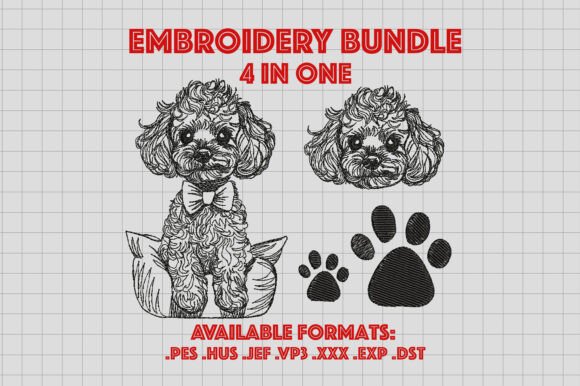
Maltipoo Machine Embroidery Design
A Friendly, Professional Touch for Small Business Branding
As an embroidery designer who’s developed hundreds of commercial designs for cafés, pet boutiques, florists, and handmade studios, my first impression of the Maltipoo Machine Embroidery Design is strongly positive—it reads as approachable, polished, and intentionally warm. The description—“an adorable Maltipoo pup” with “a charming Maltipoo with a bow”—suggests a design that leans into playful elegance rather than cartoonish exaggeration or overly rustic simplicity. That balance is critical for small business merch: it must feel human and memorable without sacrificing professionalism. For a local bakery branding aprons or a pet wellness studio embroidering tote bags, this design lands right in the sweet spot between friendly charm and visual credibility.
Real-World Performance Across Merchandise Types
The Maltipoo Machine Embroidery Design shines most consistently in applications where emotional resonance matters—customer-facing branded items like embroidered patches, staff aprons, boutique shopping totes, and cap fronts. Its compact silhouette (implied by the “pup” focus and bow detail) makes it highly adaptable across scale. As a chest logo on a linen apron? It reads clearly at 2.5–3 inches wide. As a sew-on patch for employee uniforms? It holds shape and expression without excessive stitch density. On a cotton tote bag used for client gift sets? It adds personality without overwhelming the product. Even in digital use—like a printable mockup for Etsy listings or a social media preview—the design translates well due to its strong outline and intentional negative space.
For custom apparel shops and embroidery studios, this machine embroidery design offers reliable versatility. It works cleanly on mid-weight twill (ideal for caps), stable canvas (totes, shop banners), and even lightweight poplin (staff shirts). Because it features a single focal subject—not layered scenes or intricate typography—it avoids common pitfalls like thread nesting or registration drift during high-volume production. That means fewer re-hooping stops, smoother digitizing handoffs, and faster turnaround for clients ordering 20–100 units.
Where to Use It Thoughtfully
Like any expressive digital embroidery file, the Maltipoo Machine Embroidery Design demands mindful placement. Avoid scaling it below 1.75 inches for embroidered patches—especially if the bow or facial features include fine interior stitching. On curved surfaces like cap fronts or rounded ceramic mugs (if paired with heat-transfer embroidery overlays), test stitch alignment early; subtle distortion can blur delicate contours. Dark uniforms require careful thread color selection: light tans or creams may disappear on charcoal fabric unless contrast is verified in-thread—not just on screen. Similarly, textured fabrics like bouclé or heavy linen demand extra stabilizer support to prevent puckering around the pup’s outline.
Wash durability is another practical note: while the design itself isn’t inherently high-stitch-density, any version with dense fill in the bow or eye detail should be evaluated for abrasion resistance—especially for aprons or work shirts worn daily. Always confirm whether your embroidery file includes optimized underlay and pull compensation for these areas before bulk production.
Strengthening Brand Identity and Customer Trust
For small businesses building recognition through tactile consistency, the Maltipoo Machine Embroidery Design functions as more than decoration—it becomes part of a visual signature. A florist using it on staff aprons and reusable gift totes creates continuity between service and packaging. A pet-focused subscription box brand applying it as a sewn patch on every shipment reinforces niche authority and warmth. That kind of repetition builds subconscious trust: customers begin associating the pup’s gentle expression with reliability, care, and attention to detail.
It also elevates perceived value. Handmade products—from ceramic mugs to woven blankets—gain authenticity when paired with thoughtfully executed embroidery. Unlike generic clipart or overused vector icons, a well-digitized machine embroidery design signals intentionality. Buyers notice the difference between rushed decoration and considered craft—and they’re more likely to share, tag, and return when the brand feels both personal and polished.
Practical Designer Notes for Commercial Use
Before committing to production, run these checks:
- Test in black and white first—verify readability and balance without color distraction.
- Confirm minimum viable size—stitch out the smallest patch version you plan to offer (e.g., 1.5”) on actual fabric to assess clarity.
- Review thread color contrast—especially for dark garments or textured materials where matte threads may recede.
- Inspect spacing and isolation—ensure no elements float too close to the edge or risk fraying during trimming.
- Verify hoop size compatibility—some multi-angle versions may require larger hoops than standard 4x4.
- Test on real substrate—run a sample on your go-to stabilizer/fabric combo before client approval.
- Create a physical mockup—not just a digital preview—for client sign-off, especially for uniform or retail applications.
- Compare beside existing design assets—does it harmonize with your logo, typography, and other embroidery files?
- Confirm commercial licensing—this digital embroidery file must explicitly permit resale on physical goods if used for client merchandise or Etsy branding.
Finally, remember: the strength of the Maltipoo Machine Embroidery Design lies not just in its cuteness—but in how purposefully it serves your business goals. Whether anchoring a pet brand’s identity or adding quiet charm to a café’s apron line, it performs best when treated as a strategic design asset, not just a decorative flourish. Used with intention, it helps turn everyday items—tote bags, caps, patches—into touchpoints that build loyalty, reflect values, and quietly say, “We made this with care.”